Cute Animals That Live in Deserts — 12 You Never Knew
Cute Animals That Live in Deserts: The Most Adorable Desert Dwellers You Never Knew Existed
By Jackson Galaxy, Pet Care Writer at CuteAnimals.cc · Updated 2026 · 20 min read
The Desert Surprise
Imagine this. You’re standing in the Sahara thirty minutes before sunset. The temperature has finally dropped below unbearable. You’re scanning the horizon for anything — and then, in the shade of a single scraggly acacia tree, a pair of ears appears. Not dog ears. Not rabbit ears. Ears the size of satellite dishes attached to a body the size of a small Chihuahua. The fennec fox is sitting there, perfectly still, watching you with eyes like polished obsidian, and it is absolutely, completely unbothered by your existence.
That moment — when you realize the “empty” desert has been full of life this entire time and you just couldn’t see it — is what changed how I think about these landscapes. Deserts are not absences. They are ecosystems operating at maximum creativity with minimum resources. And the animals that have solved the puzzle of living here are frequently, inexplicably, absurdly adorable.
Why? Because the same survival pressures that shaped desert life — blistering heat, freezing nights, almost no water — produced some of the most exaggerated physical features on Earth. Oversized ears that work as radiators. Enormous eyes built for seeing in starlight. Feet so wide they function as sand shoes. Pale, cream-colored fur that reflects sunlight like a living mirror. Every one of these features exists to solve a very specific survival problem. And every one of them, to human eyes, looks like something a children’s book illustrator dreamed up.
After working with and researching desert wildlife for years, the animals that surprise people most are never the ones they expected. Nobody plans to fall in love with a jerboa. And then they see one move.
The Animals: 12 Desert Dwellers That Will Rearrange Your Expectations
1. Fennec Fox
Home: Sahara and North African deserts
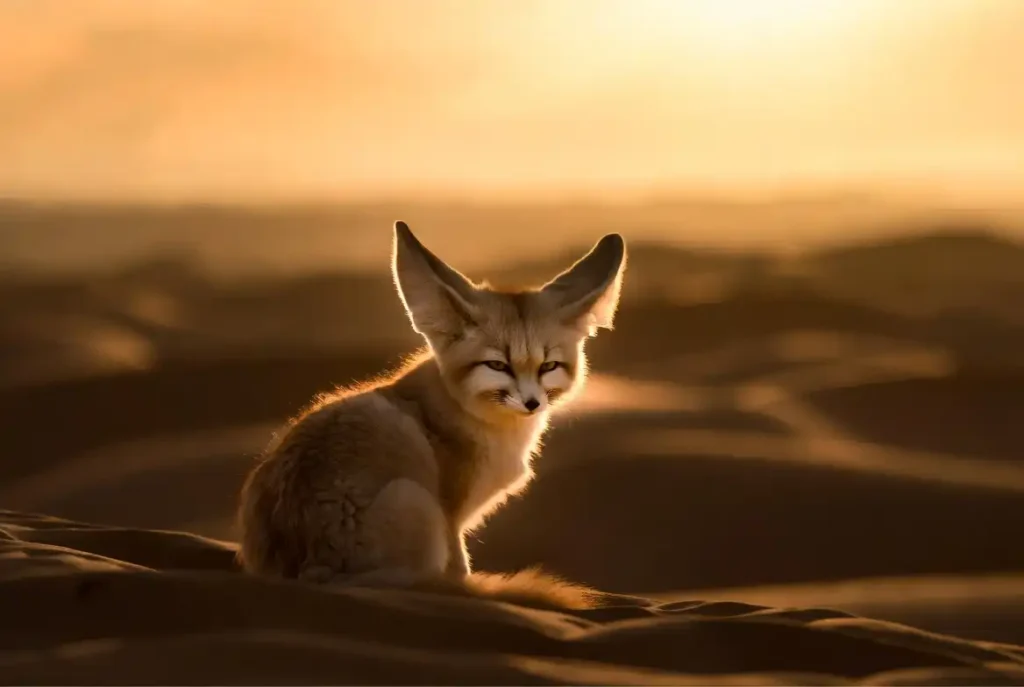
Yes, you’ve seen the fennec fox on the internet. No, that did not prepare you. Those ears — six inches long on a body that weighs less than a bag of flour — are a precision-engineered radiator system. A dense network of blood vessels runs just beneath the ear skin, releasing excess body heat into the dry desert air. They can also hear a beetle walking underground from several feet away. The fennec produces over 40 distinct vocalizations, which means a fox the size of a kitten has a bigger vocabulary of sounds than most domestic dogs. They live in family groups of up to ten, dig elaborate interconnected burrow systems, and mate for life. The reality of encountering one at dusk — sitting bolt upright, ears tracking sounds you cannot hear, amber eyes catching the last light — is more extraordinary than any photograph has ever managed to capture.
2. Long-Eared Jerboa
Home: Gobi Desert, Central Asian deserts
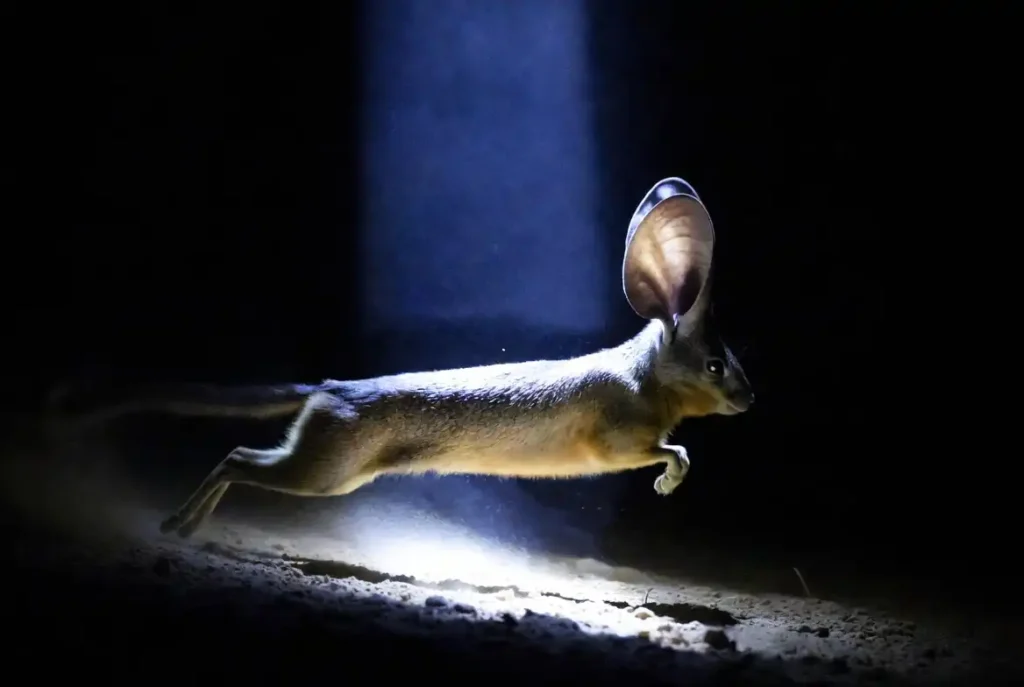
This is the hill I will die on: the long-eared jerboa is the most improbable animal on Earth. It has the body of a mouse, the ears of a rabbit, the legs of a kangaroo, and a tail longer than its entire body tipped with a white tuft. It moves in erratic, bouncing leaps across the Gobi Desert floor — think a tiny animated character who escaped from a film studio and is making a break for it. Its ears are the largest of any known mammal relative to body size. It is completely nocturnal and so elusive that it wasn’t filmed alive in the wild until a Zoological Society of London expedition in 2007. It hibernates through the Gobi’s brutal winters — unusual behavior for a desert species — and eats mostly flying insects, which it catches mid-leap. Everything about this animal feels like a rough draft that nature forgot to edit into something more plausible.
3. Addax Antelope
Home: Sahara Desert — critically endangered
The addax has long, spiraling horns that look borrowed from a mythological creature, a pale cream coat that reflects Saharan heat, and hooves so wide and flat they function as natural snowshoes on sand. But the truly staggering fact is this: the addax never needs to drink water. Not sometimes. Never. It extracts every drop of moisture it needs metabolically from the sparse desert grasses it eats — a process called metabolic water extraction. And here is the part that should make you stop scrolling: fewer than 100 addax remain in the wild. An animal that figured out how to live in one of the harshest environments on Earth is being lost to poaching and habitat disruption faster than conservation efforts can respond.
<100
Fewer than 100 addax antelope remain in the wild — one of the most critically endangered large mammals on Earth, and an animal most people have never heard of.
4. Meerkat
Home: Kalahari Desert, southern Africa
Meerkats run a rotating sentinel system that would make a military commander envious. One meerkat stands upright on the highest available point, scanning for eagles and jackals, while the rest forage. When the sentinel’s shift ends, another takes over — unprompted, uncoerced, by social agreement. They eat scorpions for breakfast (literally — they’re partially immune to the venom), and adult meerkats bring disabled scorpions to their pups to practice hunting — one of the few documented cases of deliberate teaching behavior in non-primate mammals. The dark patches around their eyes aren’t just markings — the melanin-dense fur reduces glare on the high-reflectivity Kalahari sand. They’re essentially wearing built-in sunglasses.
5. Sand Cat
Home: Sahara, Arabian Desert, Central Asian deserts
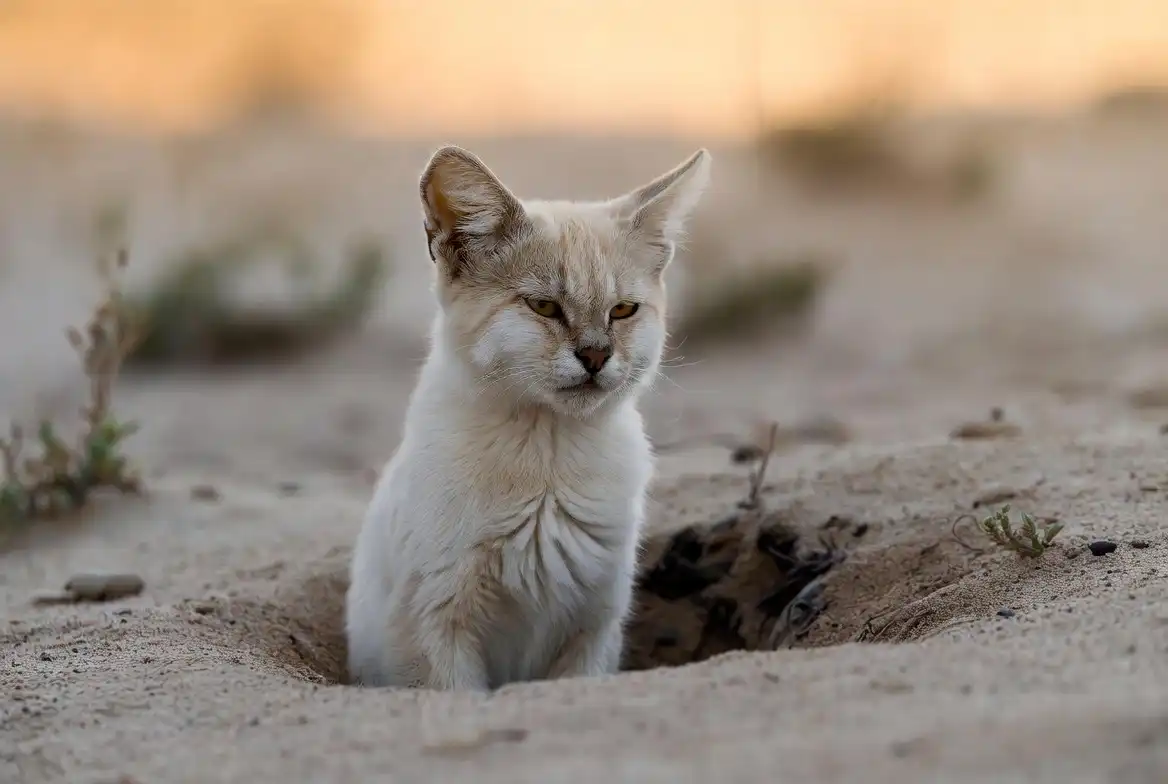
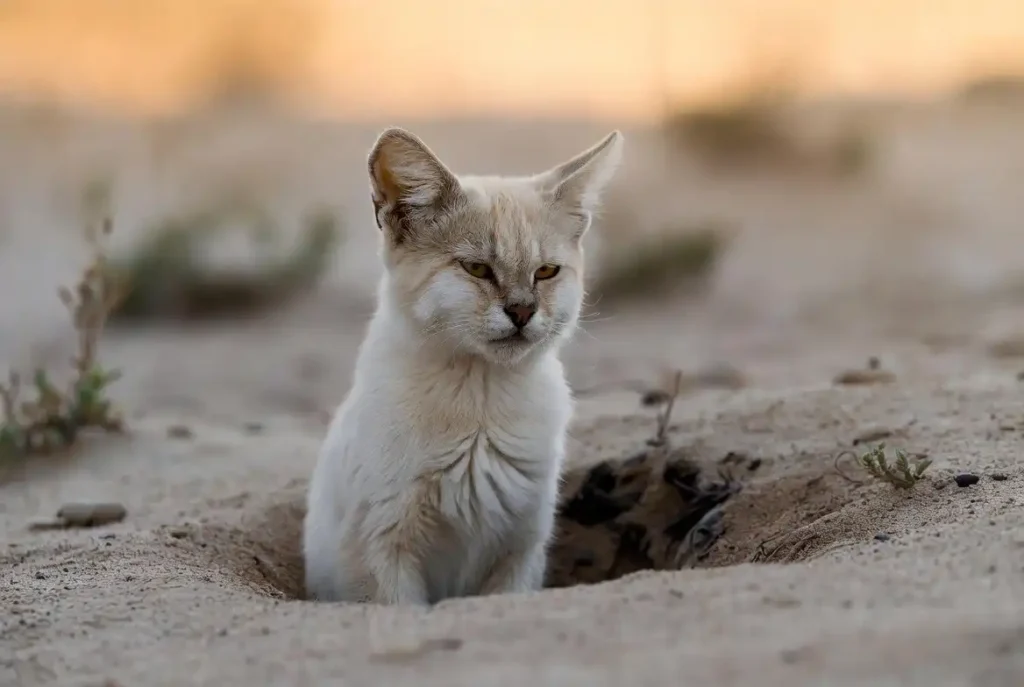
The sand cat is the desert’s ghost. Dense fur covers the bottoms of its paws, insulating against burning sand and — this is the part that drives researchers mad — erasing its footprints as it walks. It leaves almost no tracks. It survives temperature swings from freezing nights to 52°C (126°F) days. Its ears are set wide and low on its head, giving it a permanent wide-eyed kitten expression that is wildly misleading — this is a highly efficient predator that kills venomous snakes by striking with blinding speed. It is so rarely seen in the wild that its actual population size is genuinely unknown. Most of our sand cat knowledge comes from camera trap footage and the occasional stunned researcher who stumbled onto one at 2 a.m.
6. Thorny Devil
Home: Australian Outback
Covered head to tail in conical spines, walking in a slow, jerky mechanical gait that looks like a malfunctioning wind-up toy — the thorny devil is possibly the most visually dramatic small lizard alive. But the engineering underneath the drama is what makes it extraordinary. Microscopic channels between its scales use capillary action to direct any moisture — dew, rain, even humidity that condenses on its body overnight — directly toward its mouth. It drinks through its skin. It eats exclusively black ants, up to 3,000 in a single meal, picked off one at a time with a sticky tongue. When threatened, it tucks its real head between its front legs and presents a spiny false head — a knob on the back of its neck — to the predator instead. The desert built this animal as both a problem and its own solution.
7. Cape Ground Squirrel
Home: Kalahari and Namib Deserts
This squirrel uses its own tail as a parasol. While other desert animals retreat underground during midday heat, the cape ground squirrel stays topside — foraging in direct sun while holding its enormous bushy tail arched over its body as a shade canopy. Researchers have measured a body temperature reduction of up to 5°C from this behavior alone. They live in communal burrow systems shared between multiple families, engineered with ventilation shafts that create airflow underground. Their alarm calls distinguish between aerial and ground predators — a different sound for “eagle” versus “jackal” — so the colony responds with the correct evasion before they even see the threat. I will argue until someone stops me that the tail-parasol is the cleverest single adaptation in desert ecology.
8. Burrowing Owl
Home: Deserts and grasslands of the Americas
The only owl on Earth that nests underground — in burrows dug by prairie dogs, ground squirrels, or tortoises, never by the owl itself. It’s active during the day as well as at night, making it the approachable exception in a family of nocturnal loners. And here’s the fact that stops people cold: it decorates the entrance to its burrow with mammal dung. Not for insulation. Not for territorial marking. To attract dung beetles, which it then eats. This is a bird that baits its own prey by interior decorating. It can rotate its head 270 degrees and has a habit of watching humans approach with an expression of complete, unflappable philosophical calm. It looks like a tiny professor who lives in a hole.
9. Patagonian Mara
Home: Patagonian Desert, South America
The mara looks like a rabbit and a small deer had a collaboration neither of them fully understood. Long legs, compact body, alert upright ears — but it’s actually a rodent, closely related to the capybara. It runs like a dog (up to 45 km/h), sits like a rabbit (haunches tucked, ears up), and bonds like a wolf (monogamous for life — one of the few rodents on Earth to maintain long-term pair bonds). Multiple mothers in a group deposit their pups into a communal creche — a shared den guarded in rotating shifts. The Patagonian mara proves that the desert produces animals that refuse to follow the template their taxonomy suggests.
10. African Pygmy Mouse
Home: Sub-Saharan semi-arid regions
Weighing approximately 3 to 7 grams, the African pygmy mouse fits comfortably in a teaspoon. Transparent pink ears. Enormous dark eyes relative to its skull. Pale sandy fur that makes it nearly invisible on desert substrate. But the behavior that earns it a place in every desert ecology textbook: it collects small pebbles and stacks them outside its burrow entrance each evening. Overnight, moisture from temperature changes condenses on the stones. At dawn, the mouse drinks the dew. This is documented tool use — in an animal that weighs less than two sugar cubes. The tiniest rodent in Africa builds its own water collection system every single night.
11. Greater Roadrunner
Home: Sonoran and Chihuahuan Deserts, American Southwest
The actual roadrunner is somehow stranger and more impressive than the cartoon. It runs at speeds up to 26 mph and prefers running to flying in almost every situation — including hunting. It kills rattlesnakes: pins the snake’s head with its bill, lifts it, and slams it against a rock until the threat is neutralized. A bird the size of a large crow, systematically hunting venomous prey twice its body width. On cold desert mornings, it faces the sun, raises its back feathers, and exposes a patch of dark skin between the shoulder blades to absorb solar radiation — it’s warming itself with a built-in solar panel before the day starts. The cartoon was entertaining. The real bird is a masterpiece of desert problem-solving.
12. Desert Rain Frog
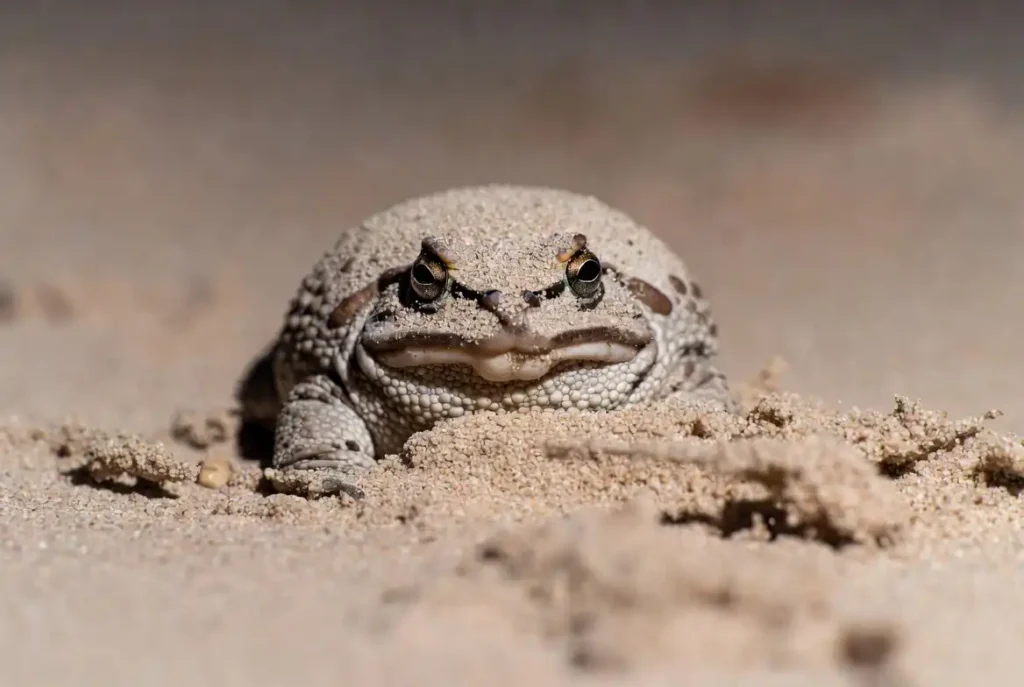
Home: Namib Desert coastal dunes, Namibia and South Africa
A perfectly spherical frog — the shape and approximate size of a ping-pong ball — living in one of the driest places on Earth. Everything about the desert rain frog feels like a dare. It never needs standing water. It absorbs moisture through its permeable belly from the fog that rolls in off the cold Atlantic and settles into the Namib’s coastal dunes. It burrows headfirst into sand when disturbed, disappearing in under a minute into substrate that shows no trace it was ever there.
And then there’s the sound. When threatened, the desert rain frog opens its tiny mouth and produces a squeak so high-pitched, so intensely indignant, so disproportionate to its round little body that the first time you hear it, you laugh involuntarily. The viral video of this sound has been watched hundreds of millions of times. The frog sounds like it’s filing a formal complaint about its own existence. It sounds like a chew toy with opinions. It is, without question, the most emotionally expressive cubic inch of amphibian on the planet.
What the wildlife footage doesn’t show you is the silence after. The frog squeaks, buries itself, and within sixty seconds the sand is smooth and empty. The desert swallowed it whole. It’s still down there, outraged, damp, thriving. There is no animal on Earth I respect more irrationally.
| Animal | Desert Region | Most Distinctive Feature | Conservation Status | Fun Rating |
|---|---|---|---|---|
| Fennec Fox | Sahara, North Africa | 6-inch radiator ears | Least Concern | ⭐⭐⭐⭐⭐ |
| Long-Eared Jerboa | Gobi, Central Asia | Largest ear-to-body ratio of any mammal | Least Concern | ⭐⭐⭐⭐⭐ |
| Addax | Sahara | Never drinks water | Critically Endangered | ⭐⭐⭐⭐ |
| Meerkat | Kalahari, Southern Africa | Rotating sentinel guard duty | Least Concern | ⭐⭐⭐⭐⭐ |
| Sand Cat | Sahara, Arabian, Central Asia | Fur-covered paws erase tracks | Least Concern | ⭐⭐⭐⭐⭐ |
| Thorny Devil | Australian Outback | Drinks through its skin | Least Concern | ⭐⭐⭐⭐ |
| Cape Ground Squirrel | Kalahari, Namib | Uses tail as sun parasol | Least Concern | ⭐⭐⭐⭐ |
| Burrowing Owl | Americas (deserts/grasslands) | Baits prey with dung decor | Least Concern | ⭐⭐⭐⭐ |
| Patagonian Mara | Patagonian Desert | Monogamous-for-life rodent | Near Threatened | ⭐⭐⭐⭐ |
| African Pygmy Mouse | Sub-Saharan semi-arid | Builds nightly dew-collection stone piles | Least Concern | ⭐⭐⭐⭐⭐ |
| Greater Roadrunner | Sonoran, Chihuahuan | Hunts and kills rattlesnakes | Least Concern | ⭐⭐⭐⭐ |
| Desert Rain Frog | Namib coastal dunes | Viral angry squeak; perfectly spherical | Near Threatened | ⭐⭐⭐⭐⭐ |
“The desert does not look empty because nothing lives there. It looks empty because everything that lives there is very good at not being seen.”
The Science of Desert Cuteness
There’s a reason so many desert animals trigger that involuntary “awww” in humans — and it has nothing to do with why those features actually evolved. The baby schema effect, first described by ethologist Konrad Lorenz, explains that large eyes, round faces, oversized heads, and compact bodies activate human protective instincts. We’re wired to find these proportions endearing because they mimic infant features.
🔬 Why So Many Desert Animals Look So Improbably Cute
Large ears: Surface area for heat dissipation. The larger the ear, the more blood flows near the skin surface, the more heat radiates away. Fennec foxes, jerboas, and kit foxes all evolved oversized ears as radiators — not decoration.
Enormous eyes: Most desert animals are nocturnal. Larger eyes capture more light. Species like jerboas and sand cats evolved eyes that can function in near-total darkness — and those proportions happen to trigger our baby schema response.
Pale, cream-colored fur: Light colors reflect solar radiation. Nearly every desert mammal converged independently on pale tan, sandy, or cream coloration — effective camouflage that also reduces heat absorption.
Compact bodies: Smaller bodies lose heat faster (higher surface-area-to-volume ratio for small species) and require less water. The concentrated proportions that result — small frame, big eyes, big ears — are the exact formula that humans find adorable.
The truly remarkable thing is convergent evolution. Desert animals on different continents, separated by thousands of miles and millions of years, independently evolved the same solutions. The fennec fox in the Sahara and the kit fox in the Sonoran both evolved oversized ears. The thorny devil in Australia and the Texas horned lizard both evolved spiny armor and ant-based diets. The jerboa in the Gobi and the kangaroo rat in North America both evolved bipedal hopping locomotion. The desert poses the same questions everywhere. And life keeps arriving at the same answers — often beautiful ones.
For more on the extraordinary diversity of the animal kingdom, explore more fascinating wild animal profiles on CuteAnimals.cc.
Desert Ecosystems — Why Context Makes These Animals More Remarkable
| Desert Type | Example Location | Climate | Featured Animals |
|---|---|---|---|
| Hot & Dry | Sahara, Arabian | Extreme heat, minimal rainfall, dramatic day-night temperature swings | Fennec fox, sand cat, addax |
| Cold | Gobi | Freezing winters, cool summers, low rainfall, extreme winds | Long-eared jerboa |
| Coastal | Namib, Atacama | Fog-fed, cool temperatures, almost zero rainfall, high humidity at night | Desert rain frog, Namaqua chameleon, cape ground squirrel |
| Semi-Arid | Patagonian, Kalahari | Moderate heat, seasonal rainfall, more vegetation than true deserts | Meerkat, Patagonian mara, African pygmy mouse |
Most people assume deserts are biologically sparse. They’re not. The Sonoran Desert alone contains over 2,000 plant species, 350 bird species, and more than 100 species of reptiles. The Namib, one of the oldest deserts on Earth, supports creatures found nowhere else. Deserts are not empty. They’re just operating on a schedule most humans don’t follow.
🌙 The Best Time to Actually See Desert Animals
Daytime visitors to deserts almost always miss the most interesting residents. The desert between midnight and 4 a.m. is a completely different ecosystem. Jerboas leap across open sand. Kit foxes emerge to hunt. Scorpions glow blue-green under UV light. Sand cats begin their patrol. If you want to see the real desert, set an alarm for 2 a.m. and bring a red-filtered flashlight (which doesn’t disturb nocturnal animals the way white light does). The desert you see at noon is the waiting room. The desert you see at midnight is the main event.
Conservation — The Honest Conversation
The same features that make desert animals extraordinary make them targets. The fennec fox and sand cat are both caught and sold in the illegal exotic pet trade — their appearance drives demand. The addax, one of the most spectacularly adapted mammals on Earth, may disappear within our lifetimes. The IUCN Red List classifies the addax as critically endangered, the long-eared jerboa as data-deficient (we don’t even know enough about them to know how endangered they are), and the sand cat’s population remains essentially unknown.
⚠️ Why Fennec Fox and Sand Cat Videos Are Contributing to a Conservation Crisis
Every viral video of a fennec fox in someone’s living room or a sand cat being held like a domestic kitten drives demand for wild-caught or poorly bred exotic pets. These animals suffer in captivity — fennec foxes need extensive digging space and specific social structures; sand cats have never been successfully domesticated. Sharing “cute pet” content featuring wild desert species normalizes ownership that is cruel to the animal and ecologically harmful. The best way to love these animals is to admire them from the right distance.
The specific threats to desert wildlife in 2026 include climate change altering the deserts themselves (shifting rainfall patterns, expanding arid zones into previously semi-arid habitat), human encroachment into remote areas, military activity across North African desert habitats, and the ongoing illegal wildlife trade. Organizations like the World Wildlife Fund and the Sahara Conservation Fund are actively working on desert species protection.
✅ DO
Support desert-specific conservation organizations
Share educational content about desert wildlife
Participate in citizen science desert monitoring programs
Visit desert ecosystems responsibly with guided tours
Advocate against the exotic pet trade
❌ DON’T
Share or engage with “pet” fennec fox or sand cat content
Purchase or seek to own wild desert animals
Approach or handle wild desert wildlife
Assume “cute” means “good pet” — it never does with wild species
Disturb desert habitats — even driving off-road damages fragile ecosystems
To discover more surprisingly cute wildlife from around the world and understand why protecting them matters, explore the full guide collection on CuteAnimals.cc.
Field Notes
Field Note 1: The Jerboa at Midnight
The first time I saw a long-eared jerboa in the wild was in the Gobi, on a night so cold I could see my breath. We’d been scanning with red-filtered headlamps for two hours and seen nothing but empty sand. Then: movement. A shape the size of a tennis ball launched itself across the beam of light in a trajectory that defied physics — not running, not hopping, but ricocheting, like a rubber ball thrown hard against the ground. It landed, froze, and for maybe three seconds those enormous ears were silhouetted against the night sky. Then it launched again and was gone.
You can’t photograph that. You can’t prepare for it. The only response is to stand there, grinning, while your camera sits unused in your hand because the whole encounter lasted five seconds. The single fact that changed how I thought about desert adaptation after that night: this animal’s ears are not primarily for hearing. They’re for thermoregulation — radiating heat in an environment that swings from 40°C days to -20°C nights. The most improbable feature on the most improbable animal exists because the desert demands it.
Field Note 2: The Outraged Frog
I was on the Namibian coast looking for fog-basking beetles when I noticed something round half-buried in the dune sand. I crouched down. A perfectly spherical frog stared back at me with an expression I can only describe as personally offended. A desert rain frog. I had been wanting to see one for years.
It squeaked. If you’ve heard the viral audio, you know — but hearing it live, from something the size of a large marble, in the dead silence of a Namib dune at dawn — it hits differently. It sounds like the frog is filing a formal grievance against reality. I laughed so hard I fell backward. By the time I sat up, the frog was gone. Headfirst into the sand, sixty seconds flat, no trace. The surface looked untouched. Nothing lives here, you’d think, looking at that smooth patch of sand. And six inches below, an outraged sphere is thriving.
🤯 Desert Animal Facts That Will Stop You Mid-Scroll
• The long-eared jerboa has the largest ear-to-body ratio of any mammal on Earth
• The addax antelope lives its entire life without ever drinking water
• The burrowing owl decorates its front door with dung to attract edible beetles
• The desert rain frog’s angry squeak video has been watched hundreds of millions of times
• The African pygmy mouse builds a stone dew-collection system every single night — and weighs less than two sugar cubes
• The roadrunner kills rattlesnakes by grabbing them behind the head and smashing them against rocks
“Most people assume desert animals are survivors despite their environment. The truth is closer to the opposite: they are masters of it. The desert didn’t defeat them. It refined them.”
Frequently Asked Questions
What is the cutest animal that lives in the desert and why don’t most people know about it?
The long-eared jerboa. Mouse body, rabbit ears, kangaroo legs, tufted tail. It moves in erratic leaping bounds across the Gobi Desert at night and wasn’t even filmed alive in the wild until 2007. Most people don’t know about it because it’s nocturnal, tiny, and lives in one of the least visited regions on Earth. Once you see one move, no other answer to this question feels right.
How do desert animals survive without drinking water — is that actually possible?
Several desert animals genuinely never drink water. The addax antelope extracts moisture metabolically from vegetation. The thorny devil channels dew and rain through skin grooves directly to its mouth. The desert rain frog absorbs moisture through its belly from fog-dampened sand. The African pygmy mouse collects condensation from stones it stacks outside its burrow. Water is everywhere in the desert — just not in the form we expect.
Can you keep a fennec fox or sand cat as a pet, and should you?
Fennec foxes are legal to own in some jurisdictions. Sand cats are generally not. Should you? No. Fennec foxes need extensive digging space, specific social structures, and produce a strong musky odor. They are not domesticated animals and suffer in typical home environments. Sand cats have never been successfully domesticated and die frequently in captivity. Every “cute pet” video you see represents an animal removed from an ecosystem that needs it. Love them from a distance.
What desert animal is the most endangered and what is being done about it?
The addax antelope — fewer than 100 remain in the wild, making it one of the most critically endangered large mammals on Earth. The Sahara Conservation Fund and the IUCN are leading reintroduction efforts from captive breeding populations, but poaching and military activity in Niger and Chad continue to threaten the remaining wild individuals. Captive populations are stable, but wild recovery is agonizingly slow.
Why do so many desert animals have such large ears compared to animals in other environments?
Large ears function as radiators. Dense networks of blood vessels run close to the ear surface, and as blood flows through, heat dissipates into the dry air. This is called Allen’s rule in biology — animals in hot climates tend to evolve larger extremities (ears, legs, tails) than closely related species in cold climates. The fennec fox’s ears are the most dramatic example: six inches long on a body that weighs about 3.5 pounds.
Is the desert rain frog real, or is that viral video edited to make it sound like that?
It is absolutely real and it absolutely sounds like that. The desert rain frog (Breviceps macrops) produces a high-pitched defensive squeak when disturbed that sounds comically indignant relative to its tiny, round body. The viral video is unedited. If anything, hearing it in person — in the silence of a Namib dune at dawn — is even more absurd than the recording suggests.
What is the best way to see desert wildlife if you visit a desert region?
Go at night. Most desert animals are nocturnal — visiting during the day means missing 80% of the residents. Book a guided night tour if available (common in the Namib, Sonoran, and parts of the Sahara). Bring a red-filtered flashlight, which allows you to see without disturbing wildlife. Stay quiet, move slowly, and look low — most of the most interesting desert animals are small, ground-level, and rely on stillness as their first defense. Dawn and dusk are the transition windows when both diurnal and nocturnal species are briefly active together.
The Desert Is Not Empty — You Just Weren’t Looking the Right Way
If you’ve spent the last twenty minutes reading about animals you’d never thought about before — a frog shaped like a marble, a mouse that builds a water collection system from pebbles, a squirrel that invented the parasol — then this article did exactly what it was supposed to do.
The desert is not an absence of life. It’s life operating at its most inventive, most extreme, and somehow most surprisingly charming. Every animal on this list solved the same impossible equation — how to stay alive where water is a rumor and shade is architecture — and came up with an answer that is both elegant and, to human eyes, deeply endearing.
The conservation note is simple and real: the same features that make these animals fascinating make them targets for the exotic pet trade and vulnerable to habitat loss. The best thing you can do is share the knowledge, not the demand. Learn their names. Understand their ecosystems. Tell someone about the burrowing owl that decorates with dung, the addax that never drinks, the pygmy mouse that weighs less than a paperclip and engineers its own dew collection system every night.
To see more of the world’s most unexpectedly adorable animals, explore the full collection on CuteAnimals.cc.
Somewhere right now, in a desert you’ll probably never visit, a long-eared jerboa is launching itself across cold sand in the moonlight — ears the size of its body, legs built for flight without wings, moving in a direction that no one could predict. And somewhere on the Namibian coast, just below the surface of a dune that looks completely empty, a spherical frog is sitting in damp sand, thriving, outraged, and absolutely fine. The desert is full. You just have to know when to look.
Written by: Jackson Galaxy, Pet Care Writer at CuteAnimals.cc
Animal lover with hands-on experience in animal care, behavior, and wildlife education. Content created using research-backed knowledge and real animal enthusiast experience.
Disclaimer: This article is for educational and entertainment purposes only. Never approach, handle, or attempt to interact with wild desert animals. Conservation status information reflects current IUCN data and may change. Always follow local wildlife guidelines when visiting desert regions.